
La Macaza was home to 28 nuclear-armed missiles during the Cold War
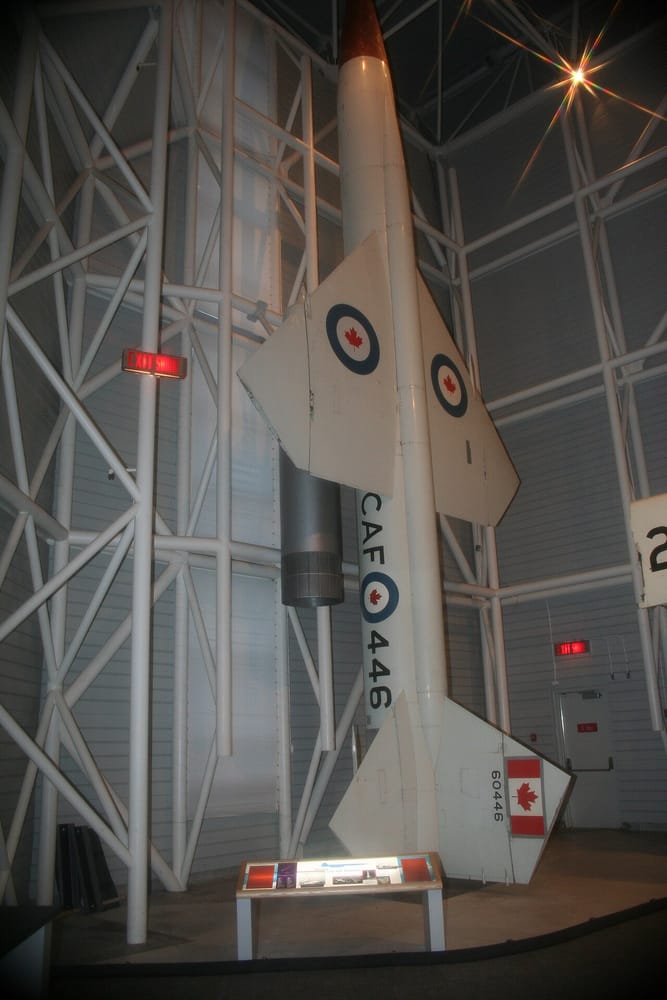
The nuclear warheads reached La Macaza in December 1963. Two weeks later, the station's 28 Bomarc missiles were declared fully operational. For close to ten years, a patch of forest east of L'Annonciation was part of North American air defence.
The Royal Canadian Air Force station and its operating unit, 447 Surface-to-Air Missile Squadron, were officially formed in 1962. Ottawa had ordered 58 Bomarc-B missiles from the Americans, half of them for La Macaza. Twenty-eight became operational there, and one more was kept for training. They sat in windowless metal shelters inside their own fenced compound.
Around them, the air force built a whole village: 114 family homes, messes, a chapel, a school and workshops where the missiles were assembled. In 1970 the base still had 285 military personnel and 74 civilian employees. For a corner of the country like ours, that was a lot of people.
What bothered Ottawa was the key.
American law did not allow nuclear warheads to be handed over to another country, so the US Air Force kept control of them. An American detachment lived on site, and a launch needed two keys, one Canadian and one American. Some federal cabinet ministers were uneasy about foreign troops guarding weapons on a Canadian base.
Things did not always run smoothly either. Historian Sean Maloney of the Royal Military College writes that a 1964 inspection found staffing problems at 447 Squadron serious enough that the warheads were nearly withdrawn. Peace activists also camped on the roads leading to air defence bases, and La Macaza drew more of them than most, since it was said to have bombs.
It was Pierre Elliott Trudeau, who had opposed the Bomarc well before he became prime minister, who closed the chapter. His 1971 defence review called for dismantling Canada's two Bomarc squadrons. 447 Squadron ended operations on May 1, 1972, and was disbanded on September 1 of that year. The missiles went back to the United States to be taken apart.
What came next is less well known. The site was transferred to the Department of Indian Affairs and Northern Development, and Manitou College moved in in 1973 after $6 million in renovations. It was a bilingual post-secondary school for Indigenous students from across Canada. It closed in December 1976. The following year, Correctional Service Canada opened La Macaza Institution, a medium-security federal penitentiary, on the same grounds.
The family homes are all gone. The launch control centre, the missile shelters, the school, the mess hall and the chapel are still there, and several shelters are now used for storage. The airstrip next door was laid out in the early 1950s as an emergency field for military aircraft. Today it is Mont-Tremblant International Airport. People who fly in for a ski weekend land on 6,000 feet of runway drawn up for the Cold War.
Photo : Bzuk, domaine public, via Wikimedia Commons